

AI website builder vs web designer is a decision many small business owners face when they need a professional website without wasting time or money. An AI website builder can create a basic website quickly, while a professional web designer can provide strategy, customization, conversion planning, and ongoing expertise. The right choice depends on what your website needs to accomplish, not simply how quickly it can be launched.
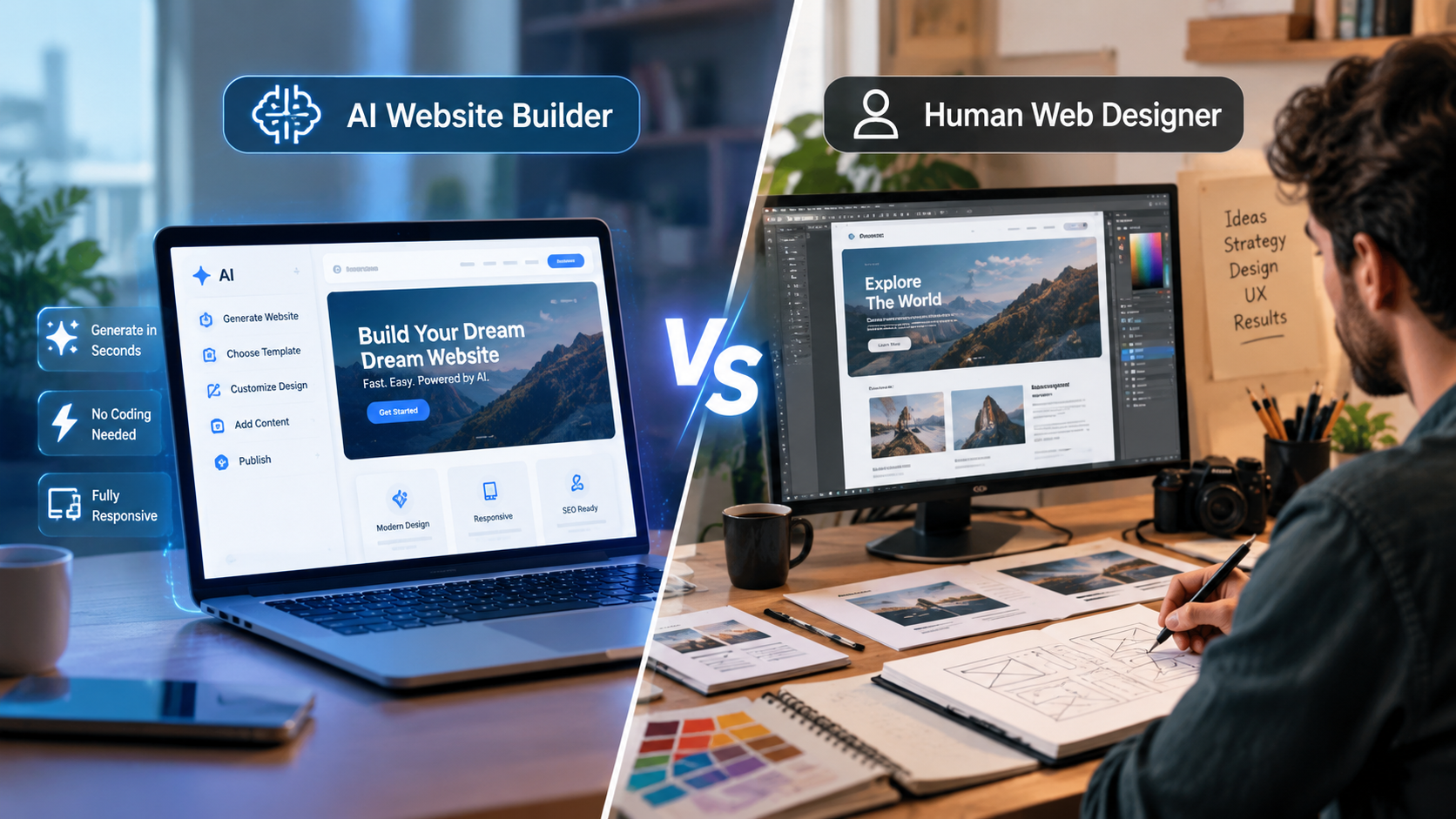
Table of Contents
AI Website Builder vs Web Designer: What Is the Difference?
An AI website builder uses artificial intelligence to generate parts of a website from prompts, business information, templates, or guided questions. Depending on the platform, it may create page layouts, write initial copy, suggest images, generate design elements, and provide basic SEO settings.
A web designer or professional web development team takes a more hands-on approach. They can research your audience, develop the site’s structure, create a visual identity, write or refine content, build custom functionality, test the customer journey, and connect the website to other business systems.
The important distinction is that an AI website builder is primarily a tool, while a professional web designer provides expertise and responsibility for the outcome.
That difference matters because a website is rarely just a collection of attractive pages. For a growing business, it may need to generate leads, explain services, build trust, rank in search engines, support sales, collect enquiries, and integrate with other tools.
AI is increasingly relevant to small businesses. A 2026 study from the Federal Reserve Bank of San Francisco found that nearly 40% of small-business respondents had either used or planned to use AI, with applications including marketing, SEO, customer service, analytics, and content creation.
When an AI Website Builder Makes Sense
An AI website builder can be a practical choice when your website requirements are relatively simple.
For example, you might benefit from an AI website builder if you:
- Need a basic business website quickly
- Have a limited initial budget
- Are comfortable reviewing and editing AI-generated content
- Have a simple service offering
- Do not require unusual functionality
- Want to experiment with a new business idea
- Have someone internally who can maintain the website
AI tools can significantly reduce the technical barrier to getting online. Modern platforms can generate an initial site from a business description rather than requiring the owner to start with a blank page.
They can also be useful for creating an initial structure. Instead of spending hours deciding whether you need pages such as Home, About, Services, and Contact, an AI tool can suggest a starting point.
However, speed does not automatically equal quality.
AI-generated copy may sound generic. Images may not represent your actual business. Calls to action may be weak. The navigation may not reflect how customers search for your services. And basic SEO settings do not necessarily mean the site has a thoughtful search strategy.
The business owner still needs to review the result carefully.
AI Website Builder vs Web Designer: Which Gives You More Control?
Control is one of the biggest differences in the AI website builder vs web designer decision.
With an AI website builder, you generally work within the platform’s available components, templates, integrations, and customization options. That can be perfectly adequate for a straightforward website, but limitations become more noticeable as requirements become more specific.
A professional designer can approach the website from the opposite direction: start with your business requirements and then determine how the site should be designed and built.
| Factor | AI Website Builder | Professional Web Designer |
|---|---|---|
| Initial setup | Very fast | Usually slower |
| Technical skill required | Low | Low for the client |
| Design customization | Usually limited to platform capabilities | High |
| Business strategy | Mostly owner-led | Can be professionally planned |
| Content | Often AI-assisted | Can be researched and professionally developed |
| SEO strategy | Basic to moderate, depending on platform | Can be built into the project |
| Custom functionality | Limited by platform | Much broader |
| Integrations | Available integrations vary | Can be planned around business needs |
| Ongoing maintenance | Usually self-managed | Can be managed for you |
| Accountability | Mostly the business owner’s responsibility | Shared with the professional team |
Neither option is automatically better.
The better question is: How important is the website to your business?
If it is simply an online business card, an AI website builder may be enough. If it is a central part of your marketing and sales operation, professional help may provide considerably more value.
When a Professional Web Designer Is the Better Choice
Hiring a professional becomes more attractive when the website has a specific business job to perform.
You may want professional web design if your website needs to:
- Generate qualified leads
- Compete for valuable search terms
- Support a strong brand identity
- Explain multiple services clearly
- Include complex forms or workflows
- Connect with CRM, booking, payment, or other business systems
- Support ecommerce
- Preserve existing SEO traffic during a redesign
- Serve multiple audiences or markets
- Scale as the business grows
This is where the AI website builder vs web designer comparison becomes less about technology and more about risk.
Suppose a business gets most of its enquiries through its website. A technically functional AI-generated site might still underperform if the messaging is unclear, the service pages do not match customer intent, or the conversion path is poorly designed.
Likewise, a business competing in organic search needs more than automatically generated title tags. It needs useful content, logical information architecture, internal linking, strong user experience, technical foundations, and ongoing optimization.
Professional support can address those wider requirements.
For businesses that need more than a website alone, WebHulks’ services combine website development with growth-focused services such as SEO, social media management, brand identity, hosting, and AI chatbot integration.
AI Website Builder vs Web Designer: What About Cost?
Cost is often the first reason business owners investigate AI website builders.
An AI website builder can reduce the amount of paid professional time required to produce an initial website. Many platforms operate on a subscription model, making the upfront financial commitment relatively small.
A professional website generally requires more investment because you are paying for human expertise as well as the technology used to build it.
But comparing only the initial price can be misleading.
A low-cost website can become expensive if you later need to rebuild it because the structure does not support your SEO strategy, the design does not reflect your brand, or the platform cannot handle a required integration.
Likewise, paying for a professional website can be unnecessary if you only need a simple temporary presence.
Think about total business value, not simply the launch price.
For a business that needs a website plus ongoing growth support, a subscription model can also change the calculation. Instead of paying separately for a website, hosting, SEO, branding, social media, and other services, businesses can evaluate whether an integrated growth service better matches their needs. WebHulks explains its broader approach on its homepage.
How to Decide Between an AI Website Builder and a Web Designer
Use these questions to make the decision easier.
1. How complicated is the website?
A simple five-page service website is a very different project from an ecommerce store, booking platform, membership website, or custom application.
2. How important is organic search?
If Google visibility is central to your acquisition strategy, consider whether you have the knowledge and time to plan and maintain SEO beyond the AI builder’s automated settings.
3. Who will create and verify the content?
AI can produce drafts, but business claims, pricing, service details, customer promises, and industry-specific information need human review.
4. Who will maintain the website?
A website is not finished simply because it has launched. Someone needs to update information, monitor forms, check integrations, review performance, and keep content current.
5. What happens if the business grows?
Choose an approach that will not create unnecessary technical or strategic limitations six months from now.
6. What does your brand need?
If your business competes primarily on price and convenience, a simple site may be enough. If differentiation, trust, positioning, and visual identity are central to your business, professional design becomes more valuable.
A useful middle ground also exists: use AI to accelerate production while having a professional handle strategy, editing, branding, SEO, testing, and launch.
That approach treats AI as a productivity tool rather than a replacement for every part of the website process.
AI Website Builder vs Web Designer: The Best Choice for Small Businesses
For many small businesses, the decision does not need to be framed as AI versus humans.
AI website builders are excellent at reducing friction. They can help business owners move from an empty screen to a usable website much faster than traditional website creation.
Professional web designers are valuable when the business needs judgment, customization, strategic planning, technical expertise, or accountability.
The best option depends on your stage and requirements:
- Choose an AI website builder when speed, simplicity, and low initial cost are your priorities.
- Choose a professional web designer when your website is strategically important, needs customization, or must support serious marketing and sales activity.
- Combine both approaches when you want AI-assisted efficiency but still need professional strategy and quality control.
The growth of AI does not eliminate the need for good websites. It changes how websites can be produced and how much of the production process can be automated.
The businesses most likely to benefit are those that use AI where it saves time while keeping human judgment where it affects customers, brand reputation, search visibility, and revenue.
Frequently Asked Questions
Is an AI website builder better than hiring a web designer?
Not necessarily. An AI website builder is often better for simple websites that need to launch quickly, while a professional web designer is usually more suitable for customized, strategic, or complex business websites.
Can an AI website builder create a professional website?
Yes, an AI website builder can create a professional-looking starting point. However, the business owner still needs to check the content, branding, mobile experience, SEO, accessibility, functionality, and customer journey before publishing.
Is it cheaper to use an AI website builder?
Usually, the initial financial cost can be lower than hiring a professional designer. However, the real comparison should include your time, future maintenance, platform limitations, additional tools, and the potential cost of rebuilding the website later.
Do AI website builders help with SEO?
Many AI website builders provide basic SEO features such as editable page titles, descriptions, headings, and technical settings. Those features can help, but strong SEO usually requires broader strategy, useful content, search-intent research, technical optimization, internal linking, and ongoing improvement.
Should a small business use AI to build its website?
It can be a good option if the business has straightforward requirements and someone is willing to review and maintain the site. If the website is expected to become an important source of leads, sales, or organic traffic, professional support may be worth considering.
If you are unsure which approach fits your business, you can book a free strategy call with WebHulks to discuss your requirements and explore the most practical option without committing to a particular approach.